 Videos
Video: I implemented Karpathy's LLM wiki method on my digital garden
I rebuilt Karpathy's LLM wiki on top of my digital garden content, with interesting results.
Talks, tutorials, and recordings.
I rebuilt Karpathy's LLM wiki on top of my digital garden content, with interesting results.
A chatty intro to my digital garden: how I use Claude Code to build an online space for thinking and writing in public.
Before 2022, it was pretty clear whether you were talking to a bot or a human. With the arrival of ChatGPT, this changed – radically. With a user interface that combines the gift of the gab with information that's not necessarily accurate, designers are faced with a novel challenge. How do we design for interfaces that are so convincing that people instinctively drop their guards and trust them more than might be good for them? And do our traditional design paradigms still serve us here?
An update on my favorite AI-tools...a never ending overview
A technical exploration of DeepSeek's content moderation and reasoning capabilities through testing its responses to sensitive geopolitical questions about Taiwan's political status. I discover that prompting DeepSeek in Dutch triggers the model's reasoning mechanism, revealing internal moderation instructions. By using linguistic workarounds like misspellings that exploit tokenization differences, I expose DeepSeek's internal guidelines for handling Taiwan-related questions, which include instructions to balance factual information with political sensitivity while avoiding language implying support for independence. This demonstrates that censorship occurs at the application level rather than within the model itself, similar to how ChatGPT handles restricted content. The model's reasoning shows it is capable of nuanced discussion about sensitive geopolitical topics, but the application layer prevents users from accessing these capabilities. I plan follow-up testing via API access, which may operate under different moderation policies than the web application, to further investigate the technical architecture of AI content moderation.
A demonstration of Google's NotebookLM interactive podcast feature, where I participate as a guest in an AI-generated podcast discussion about the Coconut research paper on latent reasoning in large language models. NotebookLM now features an interactive podcast mode (beta) that allows users to join AI-generated podcast discussions about uploaded documents. The Coconut paper introduces a breakthrough method where AI can reason in continuous latent space rather than through explicit chain-of-thought language, potentially improving reasoning for complex problems. I raise philosophical questions about verification of hidden reasoning, and critical concerns about transparency, compliance, and explainability. Latent reasoning creates a black box problem: we see inputs and outputs but cannot observe the reasoning process. I also test the feature's limits by requesting humor, making Monty Python references, and asking the hosts to switch to Dutch, revealing important insights about inclusivity, turn-taking, and accessibility in AI-generated conversations. Despite current limitations where AI hosts can become condescending or defensive, the feature represents a significant step toward more natural, bidirectional conversations with documents and AI systems.
The strawberry problem, and how one model gets it right.
A rant about LinkedIn's AI buttons.
Exploring research papers with Claude artefacts during a lunchbreak.
Building an interactive tutorial with Claude on a Sunday afternoon.
A comparative demonstration of how Claude, ChatGPT, and Gemini respond to a web app development request, showcasing Claude's superior capability to generate interactive prototypes and code. Claude outperforms ChatGPT and Gemini by directly generating interactive web app prototypes with a single prompt, rather than just providing plans or design suggestions. Claude creates functional React-based applications with visual mockups, progress bars, and interactive quiz elements in response to simple one-line prompts. The AI demonstrates impressive iterative capabilities, enhancing initial suggestions with more detailed content, interactive elements, and SVG graphics upon request. Claude seamlessly converts React components into static markdown files for alternative platforms, showing flexibility across different deployment methods. I am seriously considering switching from ChatGPT to Claude as my primary LLM due to Claude's superior practical implementation capabilities.

New roles, skills and tools for content professionals in the age of generative AI.
Episode 3 of the Maai & AI series, on how LLMs work and some of their risks.
Episode 2 of the Maai & AI series, exploring the different types of AI.
Episode 1 of the Maai & AI series, on the different types of prompting.
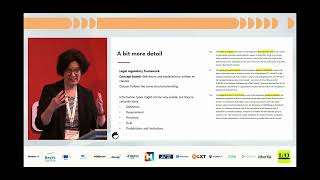
A practical guide to designing better AI interactions with documents using a systematic four-step approach that prioritizes content analysis, user needs, and task design. Content-driven interaction moves beyond simple Q&A patterns to create dynamic, purpose-driven AI interactions that leverage the intentional design embedded in documents. Analyzing your source content is the critical first step often overlooked: understanding what is in your documents, how they are structured, and what information is relevant prevents hallucinations and improves AI accuracy. The four-step methodology (analyze content, analyze users and tasks, design role and task, design interaction) creates a systematic approach to building RAG systems that actually serve user needs. Practical implementation includes welcome messages, rephrase-and-expand techniques, chain-of-thought reasoning, and step-by-step workflows that guide users through complex information.
A hands-on exploration of Microsoft Copilot for PowerPoint, testing its capabilities for presentation creation and editing, with humorous comparisons to the legacy Clippy assistant. Copilot has significant limitations in understanding context and user intent, particularly with non-English content and specific editing requests. The AI assistant struggles with co-reference resolution, making it difficult to understand which slide or element I am referring to. Copilot cannot directly access or interact with PowerPoint Online, limiting its functionality for cloud-based workflows. The fallback responses are repetitive and lack conversational variety, making the user experience frustrating. Despite being positioned as an AI assistant, Copilot performs worse than the legacy Clippy assistant from the 1990s in practical usability. Dutch language support is officially unavailable, creating barriers for non-English users even when prompting in English. My experience raises questions about the readiness of Copilot for PowerPoint as a production-ready tool for content creators.

An analysis of Chevrolet's GPT-based chatbot vulnerability and how the company successfully addressed the security issues through proper monitoring and design improvements. The initial vulnerability was not a sign of stupidity, but a necessary part of the testing process that all chatbots must undergo. The real measure of competence is not whether vulnerabilities exist, but how quickly and effectively they respond. I test the updated bot and demonstrate practical prompt engineering techniques for controlling chatbot behavior, including defensive prompting, topic maintenance, and firm responses to abuse. GPT-based solutions alone are not sufficient for high-risk transactions: a hybrid approach combining multiple design techniques is more effective.

A critical analysis of Google Bard failing to adhere to conversational principles by withholding relevant information about Gemini model availability in the EU. Bard violates Grice's Cooperative Principle by failing to proactively communicate that Gemini is unavailable in the EU due to regulatory reviews. The issue is not a hallucination but a failure of the maxim of quality: Bard does not provide necessary information unless explicitly asked. Users must already know the answer to their question before asking it, creating a paradoxical and unhelpful interaction pattern. Bard in Europe still runs on the older Lambda/PaLM model, not the newer Gemini model available in other regions. This violation of conversational principles is arguably worse than generating false information because it presupposes user knowledge.
A tutorial on three essential prompting techniques to make ChatGPT more conversational and natural. I demonstrate the problem with ChatGPT's default responses, which are too long, impersonal, and unengaging for conversational interfaces. The three tips: use OpenAI Playground instead of ChatGPT for better control over LLM behavior and access to system prompts, define a specific expert role in the system prompt rather than the generic helpful assistant since research shows expert roles result in higher quality answers, and prompt for specific behaviors like conciseness, staying on topic, and ending messages with questions to drive conversation forward. I use structured delimiters to organize prompt sections and demonstrate how each behavioral instruction refines the bot's personality and interaction style. The process is like chipping away at a block of marble: each prompt chips away at behavior, domain, interaction models, and persona until you get the conversational bot you want.
A candid reflection on the challenges of course creation, AI tools, and the mismatch between linear workflows and my non-linear thinking style. I struggle with completing online courses due to procrastination, changing circumstances, and self-doubt about content value. AI writing tools like Jasper.ai can be counterproductive for non-linear thinkers, requiring extensive prompting that defeats the purpose of automation. Linear workflows imposed by course creation platforms and AI tools conflict with my chaotic, organic thinking process. System prompts have become invaluable personal tools for managing rumination and decision-making in my daily life. I am actively seeking to design custom system prompts that accommodate my unique thought patterns rather than conform to existing frameworks.
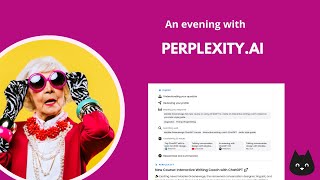
A comprehensive walkthrough of Perplexity AI, a generative AI search platform that combines web search capabilities with language models to provide verified sources and contextual follow-up queries. I explore the clean, minimal interface, the two distinct modes (Knowledge Retrieval for answering questions and Co-pilot Mode for task execution), semantic search facets (Academic, Wolfram Alpha, YouTube, Reddit, Wikipedia), and the AI Profile personalization feature. The platform maintains transparency by consistently referring to itself as Perplexity rather than using first-person pronouns. Integration with Wolfram Alpha provides computational power that traditional language models lack. I use this daily across multiple devices and it is quickly becoming my favorite generative AI search tool.
Quickstart SSML les 2: de SSML-simulator.
Quickstart SSML les 3: de basiselementen.
Quickstart SSML les 4: SSML invoeren in Dialogflow.
Quickstart SSML les 5: moeilijke woorden.
Quickstart SSML les 1: intonatie.

A presentation exploring my transition from technical writing to conversation design, discussing how communication professionals are evolving their roles in the digital landscape. I explain that conversation design goes beyond simple chatbot scripting or dialogue trees, involving understanding user needs, communication patterns, and designing interactions that feel natural and helpful. Technical writers are well-positioned for this transition because their core skills, clarity, user focus, and structured thinking, are exactly what conversation designers need. The shift is not about learning entirely new skills but about applying existing expertise in a new context, leveraging experience with documentation, user guides, and information architecture while expanding into dialogue design, tone and voice development, and interaction patterns. The future of technical communication is conversational, and the intersection of technical writing and conversation design represents how organizations will interact with their users in an increasingly digital world.
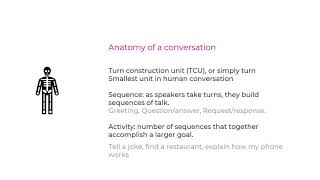
An intro to the Natural Conversation Framework for modeling conversational agents.