
A digital garden as central space for my thoughts and writing
Why I built a digital garden: non-linear thinking, early web nostalgia, and the need for a personal space on the internet.
One thing that I really miss doing lately, is writing longer pieces that require a bit of thinking, mulling and reordering. I typically resort to videos nowadays, and, to be honest, Claude is a pretty mean writing assistant for factual, functional texts. But I really miss sitting in front of a screen that doesn’t talk back, doesn’t distract and just offers me space for my own head.
Thing is: I did start writing on Substack, and even revived my Wordpress blog that I started all the way back in 2003, but when you’re used to the conveniences of jotting a quick note on LinkedIn, or generating quick drafts with Claude, starting a new blog in Wordpress feels like moving to prehistory again. It’s not the writing per se, but the backlinking, the categorying, the tagging, the finding-an-image-for-the-frontpage…ugh!
Plus, my content lives in so many places now: a Youtube channel, a Substack, a Medium, a Notion library, and various link collections. And I’m not even mentioning my huge stack of paper notebooks here.
Where’s my head at?
My head is pretty non-linear: if you mention one topic, it just goes of on a tangent, and I honestly have no idea where it will end up. Typically, that involves resurfacing old references to books, articles, and especially music, and connecting them in weird ways. It looks a bit like this.
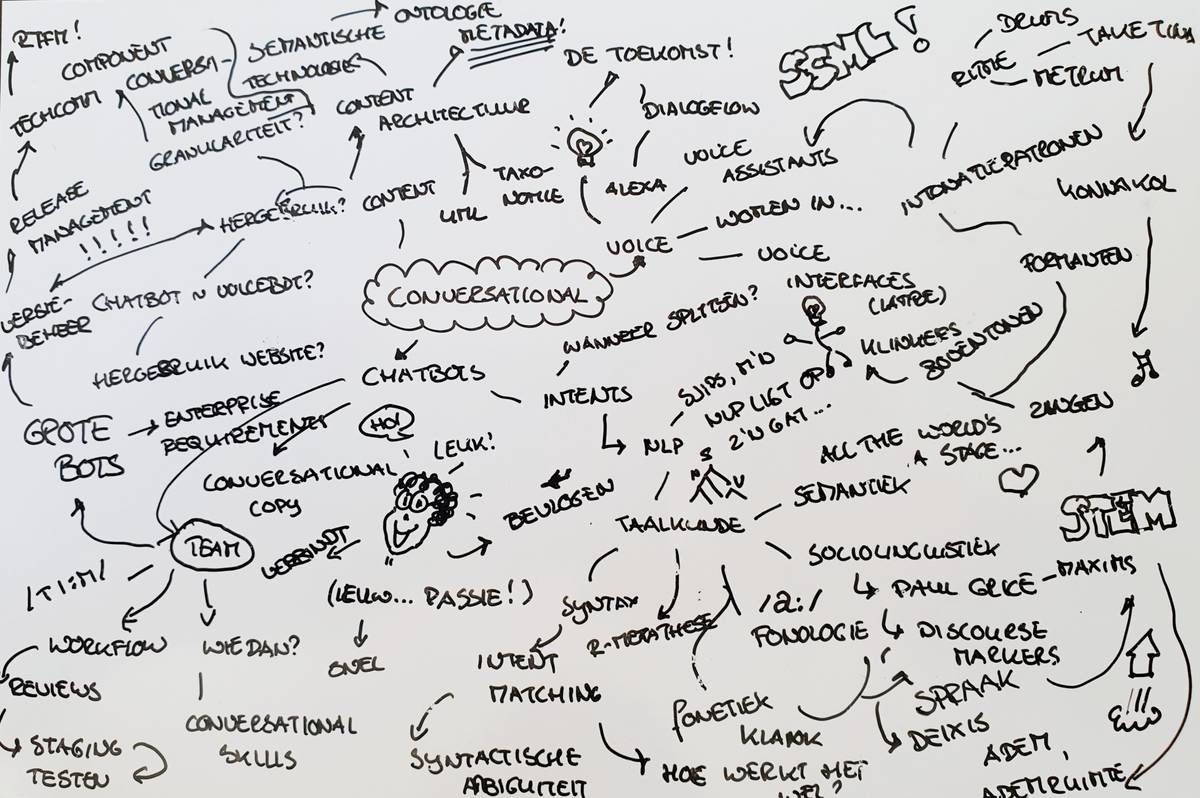
I’ve always longed for a way to express that process in writing:
- non-linear, associative
- not every idea is fully formed yet, some ideas are just fleeting thoughts and sounds, others are thinking pieces that keep surfacing in my mind for longer periods of time.
- autonomy, freedom of thinking, both in form and content
- all my stuff in one place, unorganised
- serendipity as an organising and ordering principle
- me doing the writing, but with AI in a serious role. Metaphor: to be explored.
- ambachtelijk is the Dutch word for ‘artisinal’. It’s what I always enjoyed in writing and blogging pre-algorithm, the sense that you’re crafting something.
Digital garden: a wonderfully useful metaphor
Last week, I stumbled across Maggie Appleton's history of digital gardens, a beautiful, non-linear knowledge collection of all kinds of information: from deeply-researched, well-written essays to short blurbs on personal life events. The underlying metaphor, a garden, allows for a new and refreshing take on blogging:
A garden is a collection of evolving ideas that aren’t strictly organised by their publication date. They’re inherently exploratory – notes are linked through contextual associations. They aren’t refined or complete - notes are published as half-finished thoughts that will grow and evolve over time. They’re less rigid, less performative, and less perfect than the personal websites we’re used to seeing. (source)
This sounded so refreshing and familiar at the same time: it’s how I built my very first website back in 1995 on Geocities: pure HTML (in Notepad) and nothing else. I don’t even think CSS was a thing yet, I used tables to get a slightly decent layout. Unfortunately, I don’t think that site exists any longer, but I do remember both the joy of turning your site in preview mode and seeing your layout come into existence, and the total freedom: we didn’t have templates, rules, or anything; Jakob Nielsen still had to write Designing Web Usability. Search didn’t exist (we used webrings to link to like-minded people. It would be at least a decade before the first algorithms would be introduced. It was basically up to all of us to think of how we’d like to use our websites.
When ‘homepage’ meant ‘home’ and things were allowed to be under construction
The result: a web of highly personal, intimate and unique websites where homepage literally meant home: your spot on the web where you had the full creative freedom for expressing your own ideas in any shape or form you like (and could build in plain HTML). No distraction, no assistance, just me and Notepad (and ok, later on Microsoft Frontpage :-) ). For an impression of what that looked like: visit One Terabyte of Kilobyte Age, a beautiful archive of old Geocities pages.
One thing that immediately comes to mind when I think back to that period is to ever-present ‘Under construction’ image. Preferably an animated gif. With glitter. Here’s what that looked like (from the wonderful Under Construction archive). Things in the early days were OK to be unfinished, rough and unpolished. That Under Construction sign signalled the optimism of the early web builders: we’ve just arrived, and there will be more. Stay curious, come back!

And this is such a far cry from how I experience today’s internet. Not only does everything have to fit into a template; with AI-generated content, I’m not even reading you (or me) anymore. And to be honest: I hate that. But that’s for another post. The thought of being able to return to that state of writing real stuff, not having to worry about polishing it before putting it live, thinking in public; to have an ecosytem of interlinked ideas and texts in different stages of maturity and scope, and basically find a way of communicating that fits my head, rather than the other way round…a digital garden seemed like a good fit!
The garden is our counterbalance. Gardens present information in a richly linked landscape that grows slowly over time. Everything is arranged and connected in ways that allow you to explore. Think about the way Wikipedia works when you’re hopping from Bolshevism to Celestial Mechanics to Dunbar’s Number . It’s hyperlinking at it’s best. You get to actively choose which curiosity trail to follow, rather than defaulting to the algorithmically-filtered ephemeral stream. The garden helps us move away from time-bound streams and into contextual knowledge spaces. (source)
So yes, a digital garden…
After reading Maggie’s blog, I felt really energised and ready to try this out myself. So I started researching microblog templates, Personal Knowledge Systems and indie website builders. Found a whole niche of the internet that’s still alive, kicking and federated. And then discovered that this still wasn’t exactly what I wanted: I need to be able to add links to my site from my phone, I don’t need a full-blown CMS, I like having AI for automation and batch operations. And I want to be able to catch thoughts while writing, without having to leave my writing environment.
This idea has been living in my head for ages: it’s kind of conversational, but it’s a conversation of me with me, without necessarily expecting an answer, but with a mechanism that catches that train of thought: my train of thought. Something that doesn’t interfere and is quick enough to keep up. It’s a conversation that responds in another space.
The more I researched, the more I realised that I was still in the ‘one template & concept of operations fits all’ space. If I really wanted to build a digital garden that I’d be sure to attend and curate, I needed a personal system that I could shape and extend exactly the way I envisioned. And that would let me write and publish from day 1, as you can read in the changelog - no interference with what was living in my head already.
So I turned to Claude Code. And here we are.
That was four days ago…
Oh, time to get to work, will keep working on this article later on.