
Thinking in action: precision matters
On the importance of precise terminology and definition, and a brief exploration of dialectic thinking. It's humans that need to learn to reason, not LLMs
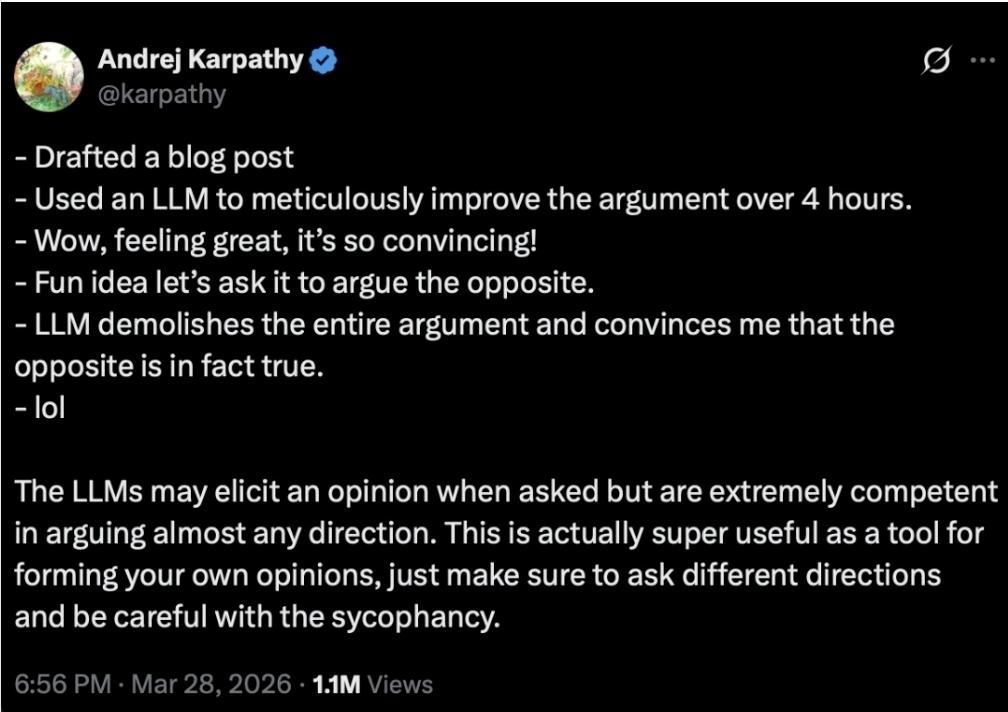
Andrej Karpathy’s tweet is a nice example of dialectic thinking in action, and a great reminder of the importance of precise terms and definitions to help us think about thinking.
Useful terms: 🔹 Opinion: a personal position that is subjective and requires no reasoning to support it. 🔹 Conviction: a conviction is a firmly held belief that someone considers part of their identity. It is stronger than an opinion and more conscious than a core belief. 🔹 Core belief / schema: a core belief is a persistent and often unconscious assumption about yourself and your world. It’s where your convictions and opinions come from. 🔹 Argument: a logical structure that consists of premises, reasoning, and a conclusion. It builds a case in one direction, there’s no inherent truth or factuality in an argument itself. 🔹 Rhetorical construction: language designed to persuade. It may look like an argument but doesn’t have to be one. Typically uses tropes and stylistic devices to persuade and move.
Dialectical thinking comes from the philosopher G W F Hegel (funny, I always call him just Hegel…was he a Georg? Or more of a full Georg Wilhelm Friedrich?) who proposed that we develop our understanding through 3 steps: thesis-antithesis-synthesis. You begin with an initial position, next confront it with a counterposition that challenges it. The tension between thesis and antithesis leads to synthesis: a deepening of your understanding that contains elements of both.
Ironically, it’s not so much the LLM that’s to blame here, but our own innate tendency to -not- do dialectic thinking, and simply stick to our convictions and opinions instead. Yet another reason to move our focus away from technology to humanity, and start practising critical thinking skills, rhetoric and philosophy.
Fun experiment: instruct your chat app to practise dialectical thinking, and you’ll have a little bot that starts challenging you with antitheses, rather than confirm your own convictions and opinions.
Happy antithesing!